
The CLEAR Coaching Model Framework
The problem this solves
Client drop-off is one of the most expensive problems in a coaching business. You invest time and energy into acquiring a client, deliver a strong first session, and then somewhere around session three or four, engagement fades. The client cancels, reschedules repeatedly, or simply stops booking. The frustrating part is that the coaching itself might have been excellent. The problem was the relational container around it.
Many coaching frameworks focus heavily on problem-solving mechanics and skip the relational infrastructure that keeps clients engaged over time. They treat each session as a standalone event rather than part of an ongoing partnership. This creates a pattern where clients get quick wins but never build the sustained momentum that leads to transformation and long-term retention.
The CLEAR model, developed by Peter Hawkins, addresses this directly. It front-loads relationship building through explicit contracting and deep listening before moving into exploration and action. This creates a coaching experience where clients feel genuinely understood, not just processed through a methodology. The result is stronger engagement, longer retention, and better outcomes.
The Framework
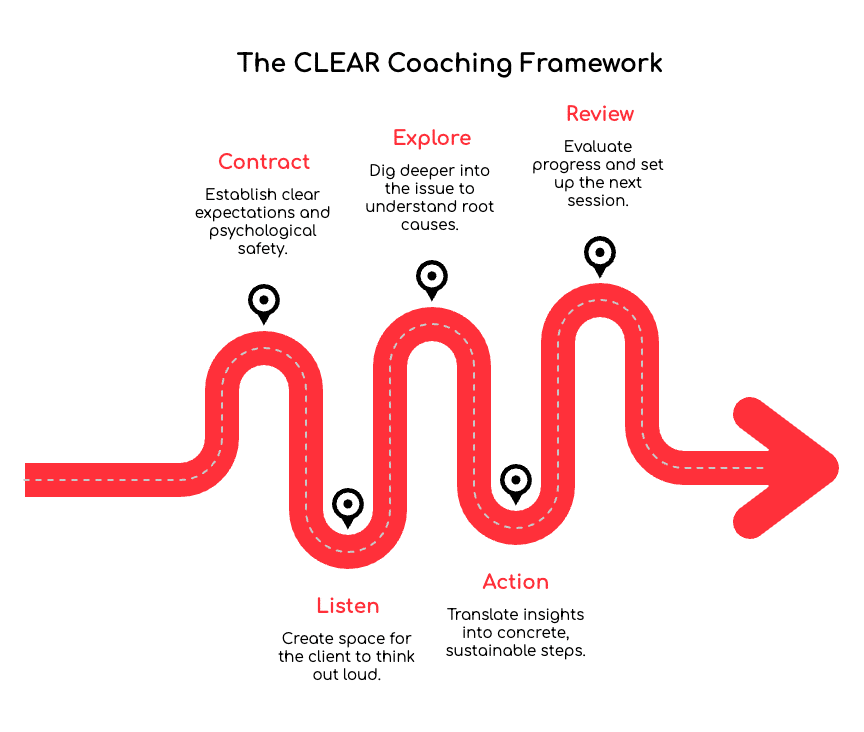
CLEAR is a five-stage coaching model that emphasizes the relational dimension of coaching alongside the problem-solving dimension. It was designed for coaches who work in ongoing relationships rather than one-off sessions. The stages flow naturally from establishing the partnership to reviewing progress, creating a complete cycle that strengthens with each repetition.
Component 1: Contract
The Contract stage is where you and the client explicitly agree on what this coaching session (and the broader engagement) will focus on, how you will work together, and what each person’s role is. This is not a legal contract. It is a working agreement that sets expectations and creates psychological safety.
In practice, contracting sounds like: “Before we begin, I want to make sure we are aligned. What is most important for you to address today, and what would make this session feel worthwhile?” You are also contracting around process: “I may challenge you on some assumptions today. Is that something you are open to?”
For coaches who work in packages, the Contract stage also covers the arc of the engagement. What does the client want to have achieved by the end of six sessions? Revisiting this macro-contract periodically prevents scope creep, misaligned expectations, and the slow drift that leads to clients feeling like sessions have become unfocused.
Component 2: Listen
The Listen stage goes beyond standard active listening. In CLEAR, listening means creating space for the client to think out loud without the coach steering toward solutions. This is where you hear not just the words but the patterns beneath them: what the client emphasizes, what they avoid, where their energy shifts, and what emotions surface.
Most coaches underestimate how rare genuine listening is in their clients’ lives. Business owners, entrepreneurs, and professionals are surrounded by people who want to give advice, sell them something, or redirect the conversation. A coach who truly listens, without an agenda beyond understanding, provides something the client cannot get anywhere else.
Practically, the Listen stage means resisting the urge to ask your next clever question while the client is still talking. It means tolerating silence. It means reflecting back what you heard in a way that shows you understood not just the content but the significance.
Component 3: Explore
The Explore stage is where you and the client dig deeper into the issue together. Unlike the Options stage in GROW, which focuses on generating solutions, Explore focuses on understanding the full landscape of the challenge. You are not solving yet. You are mapping the territory so that when you do move to action, the solution addresses root causes rather than symptoms.
This stage often involves helping the client see connections they have missed. A coach struggling with pricing might discover during exploration that the real issue is not market positioning but a belief that their experience is not valuable enough to command higher rates.
Exploration tools include perspective-shifting questions, pattern identification, and gentle confrontation. The goal is expanded awareness, not a specific answer.
Component 4: Action
The Action stage translates exploration insights into concrete next steps. Because you have invested more time in understanding the full picture, the actions that emerge here tend to be more targeted and more sustainable than quick-fix solutions.
Effective action planning in the CLEAR model considers the client’s capacity and context. A coach who is already overwhelmed does not need five new action items. They might need one carefully chosen action and permission to let everything else wait.
Actions should be specific enough to be unambiguous and meaningful enough to matter. If an action does not connect back to the insights uncovered during Exploration, it is probably a surface-level fix.
Component 5: Review
The Review stage closes the loop on the current session and sets up the next one. This is where you and the client step back and evaluate what happened in the conversation itself: what was most useful, what shifted, what still feels unresolved.
Review also covers the coaching relationship. “How is our work together feeling to you? Is there anything you need more or less of from me?” This ongoing feedback loop prevents the slow build-up of unspoken dissatisfaction that causes clients to leave without explanation.
For multi-session engagements, the Review stage includes tracking progress against the original contract, creating accountability, celebrating progress, and providing natural checkpoints for adjusting the coaching plan.
How to use this framework
Start by adding an explicit contracting conversation to the beginning of your next client session. Even if you have been working with this client for months, pausing to align on the session focus signals a shift toward more intentional partnership.
The biggest adjustment for most coaches is slowing down the transition from listening to action. If you typically spend the first ten minutes hearing the client’s situation and then shift into problem-solving mode, try doubling your listening time. Stay in the Listen and Explore stages until you notice a genuine shift in the client’s understanding.
Build the Review habit by reserving the final five minutes of every session for it. Ask three things: what was most valuable today, what action are you committing to, and is there anything about how we are working together that you would like to adjust.
When this framework doesn’t apply
CLEAR is designed for ongoing coaching relationships and works best when you have multiple sessions with the same client. If you are doing one-off strategy sessions, paid workshops, or single consultations, a more structured model like GROW is a better fit for standalone sessions.
CLEAR also requires a level of emotional intelligence and relational comfort that newer coaches may still be developing. The listening and exploration stages demand that you sit with ambiguity and resist the urge to provide answers. If you find yourself struggling with the open-ended nature of CLEAR, start with GROW to build your structural confidence, then layer in CLEAR’s relational elements as you grow more seasoned.
Related hub pages:
- How do I get coaching clients who stay long-term?
- How do I keep coaching clients from dropping off?
- Retainer Client
- Coaching Package
Related editorial:
- 6½ Powerful Coaching Models To Transform Your Coaching (COACHILLY MAG editorial)
Keep Your Clients Longer with Better Systems
Professional coaching infrastructure that supports client retention and smooth operations from session one.
