

Key Takeaways
Choosing the right scheduling tool is one of the quieter decisions that shapes your coaching business. The tool you pick determines how easy it is for clients to book you, whether you collect payments upfront, how professional your booking experience looks, and how much time you waste on calendar coordination each week. This guide compares seven scheduling tools for coaches: Calendly, Book Like A Boss (BLAB), Acuity Scheduling, Appointlet, HubSpot Meetings, TidyCal, Bonsai, and Trafft. Each has a different strength, from affordable lifetime deals to all-in-one business management. The right choice depends on your coaching stage, your budget, and whether you need scheduling alone or a broader toolkit that handles payments, intake forms, and package delivery.
Why Scheduling Quietly Decides Whether Clients Book
The discovery call is the first real experience a prospective client has of your coaching business. Everything they have seen until that point is marketing. The booking flow is the first moment of operational contact. If it is clunky, confusing, or forces them to email back and forth to find a time, many of them will drop off before they ever speak with you.
Scheduling is not a back-office detail. It is part of your sales funnel. The tool you choose either removes friction or adds it.
Most coaches underestimate how much this matters because they already trust their own expertise. They think “once they get on the call, they will book.” But getting them on the call is the hard part. A smooth booking experience signals professionalism, respects the client’s time, and closes the loop between marketing interest and actual conversation.
This is why we looked beyond generic scheduling reviews and focused on tools that actually fit how coaches work.
Table of Contents
What Coaches Actually Need From a Scheduling Tool
Coaches have specific needs that generic scheduling reviews often miss. Six criteria matter more than feature checklists.
Simple booking flow. The fewer clicks between “I want to book” and “I am booked,” the better. Every extra step costs you clients.
Intake questions built in. Coaches need to know who they are meeting before the call starts. A good scheduling tool lets you ask 3-5 qualifying questions at booking time.
Payment collection. Whether you charge for discovery calls, sell packages, or run paid strategy sessions, the tool should accept payments at booking without sending clients to a separate checkout.
Package and bundle support. Coaches sell blocks of sessions more often than single meetings. Your scheduling tool should let clients book one session from a package they already purchased.
Reminders and no-show protection. Automated email and ideally SMS reminders. No-shows cost coaches real revenue, and good reminders cut them dramatically.
Calendar integration. Google Calendar, Outlook, and iCal support are table stakes. If a tool does not sync bidirectionally with your existing calendar, skip it.
With those criteria in mind, here are seven scheduling tools worth your time.
1. Calendly: The Category Leader (But Pricier in 2026)
Calendly is the tool everyone knows. It pioneered the “share your booking link” model and still dominates market share. For many coaches, it is the default choice simply because every prospect already knows how to use it.
Calendly works well if you need reliability, broad integrations, and a booking experience your clients will recognize instantly. It connects to Google Calendar, Outlook, and iCloud, offers email reminders on paid plans, and integrates with Stripe and PayPal for payment collection.
Where Calendly falls short for coaches: The free plan is heavily limited (one event type, single calendar, no reminders). The Standard plan at $10 per user per month (annual billing) unlocks most of what coaches actually need, but costs add up if you have multiple coaches on your team. Calendly is scheduling-first, which means you will need separate tools for landing pages, deeper intake forms, and package delivery.
Pricing (2026): Free plan available with significant limitations. Standard plan $10/user/month billed annually or $12/user/month billed monthly. Teams plan starts at $16/user/month annually. Enterprise pricing is custom. Source: Calendly official pricing, verified February 2026.
Best fit for: Coaches who want a reliable, well-known scheduling tool and do not need landing pages or package management built in.
2. Book Like A Boss (BLAB): The Swiss Army Knife of Scheduling
Book Like A Boss stands out because it bundles scheduling with landing pages, payment collection, custom branding, and coupon creation. For new coaches who do not yet have a full website, BLAB can replace three or four separate tools.
What coaches love about BLAB is the breadth. You get a scheduling automation tool, customizable landing pages that match your brand, payment integration, Zoom integration, website embedding, and the ability to create discount codes for promotions. It is genuinely a coach’s Swiss Army knife.
The BLAB advantage for coaches without a website: Many new coaches delay launching because they think they need a full WordPress site first. BLAB lets you skip that step entirely. Your BLAB page can serve as your primary web presence while you focus on landing clients.
Pricing: Use our referral link to start at $8.33/month.
Best fit for: New coaches without a full website, coaches who want an all-in-one scheduling + landing page + payments solution, and anyone who prefers a one-time purchase over monthly subscriptions.
3. Acuity Scheduling: Powerful, Polished, and Built for Service Businesses
Acuity Scheduling (now owned by Squarespace) is one of the most popular alternatives to Calendly among coaches, especially those running package-based practices or needing deeper intake forms.
Acuity’s strength is its service-business DNA. Unlike Calendly, which started as a simple meeting scheduler, Acuity was built from day one for businesses that sell services, collect payments, and manage packages. This makes it a natural fit for coaches who sell session bundles, run group programs, or need clients to fill out detailed intake forms before booking.
What Acuity does well for coaches: Sell session packages and memberships directly through the booking flow. Detailed intake forms with conditional logic. Payment collection via Stripe, Square, or PayPal. Calendar syncing with Google, Outlook, and iCloud. Email and SMS reminders (SMS requires the Growing plan or higher). HIPAA compliance available on the Powerhouse plan for wellness and therapy-adjacent coaches.
Where Acuity falls short: No free plan. You get a 7-day trial, then you pay from day one. Pricing is higher than Calendly’s equivalent tier. SMS reminders, which meaningfully reduce no-shows, are locked behind the Growing plan at $27/month.
Pricing (2026): No free plan. Emerging $16/month (annual) or $20/month (monthly). Growing $27/month (annual) or $34/month (monthly). Powerhouse $49/month (annual) or $61/month (monthly). Source: Acuity Scheduling pricing, verified February 2026.
Best fit for: Coaches who sell packages or memberships, need detailed intake forms, or want SMS reminders and payment collection built into one tool.
4. Appointlet: Affordable, Flexible, and Coach-Friendly
Appointlet is an easy-to-use alternative to Calendly that many coaches choose for its affordability, flexibility, and responsive customer support. It includes all the core features you expect (calendar syncing, booking links, integrations) but stands out by making the booking experience simple for both you and your clients.
What coaches appreciate most is Appointlet’s ability to handle different meeting types with different rules. You can run one-on-ones, group sessions, and workshops from the same account, each with its own availability windows and intake form. This flexibility matters for coaches who sell multiple service tiers without wanting to juggle multiple tools.
Where Appointlet shines for coaches: Flexible meeting types with distinct rules for each. Custom intake forms to collect qualifying information at booking. Calendar sync with Google, Office 365, and Outlook. Payment acceptance for paid sessions. Automated reminders to cut no-shows. A genuinely useful forever-free plan. Responsive customer support.

Where Appointlet falls short: It is less known than Calendly or Acuity, which means some clients may find the interface unfamiliar. The branding customization is lighter than BLAB or Bonsai if you want your booking page to match a polished brand identity.
Pricing: Forever-free plan available. Paid plans start at around $10/month and scale for teams. Source: Appointlet pricing, verified 2026.
Best fit for: Coaches who want a clean, affordable scheduling tool with flexible meeting types and excellent support, without paying Calendly-level prices.
5. HubSpot Meetings: Built Into Your CRM
HubSpot Meetings is the scheduling tool built into the HubSpot CRM. If you already use HubSpot to track leads and clients, this is the easiest integration you will find because it is not an integration at all. It is the same platform.
Where HubSpot Meetings shines for coaches: Native integration with HubSpot CRM (lead capture, deal tracking, email sequences). Multiple meeting length options on the same booking page. Custom intake forms. Individual or group meeting scheduling. Website embedding without coding. The basic HubSpot CRM, including the meeting scheduler, is entirely free.
HubSpot Meetings works especially well for coaches who want their booking activity to flow directly into their customer relationship management system. When a prospect books a discovery call, their contact information lands in your CRM automatically. No Zapier, no manual entry, no gaps between your sales conversations and your client records.

Where it falls short: If you are not already using HubSpot, adopting it just for scheduling is overkill. The free tier is generous but locked to HubSpot’s ecosystem. If you ever leave HubSpot, you take your scheduling with you.
Pricing: Free as part of HubSpot’s free CRM tier. Paid HubSpot tiers start at $20/month for more advanced features. Source: HubSpot pricing, verified 2026.
Best fit for: Coaches already using HubSpot CRM, or coaches who want a genuinely free scheduling tool and do not mind adopting a broader CRM platform. your contacts from within the app and either manually or automatically add your calendar link.
6. TidyCal: The Lifetime Deal That Replaces Your Subscription
TidyCal is the scheduling tool for coaches who are tired of paying monthly fees. Created by AppSumo, TidyCal offers a lifetime license for a one-time payment, meaning you pay once and use it for the rest of your business life. For coaches running on a budget, the math is impossible to ignore.
TidyCal is not the most feature-rich tool on this list. It is positioned as “the simple, no-fuss version” of bigger scheduling platforms. But for many coaches, that is exactly the point. The tool is robust, easy to set up even for non-technical users, and reliably does what you need it to do: let clients book appointments on your calendar without back-and-forth.
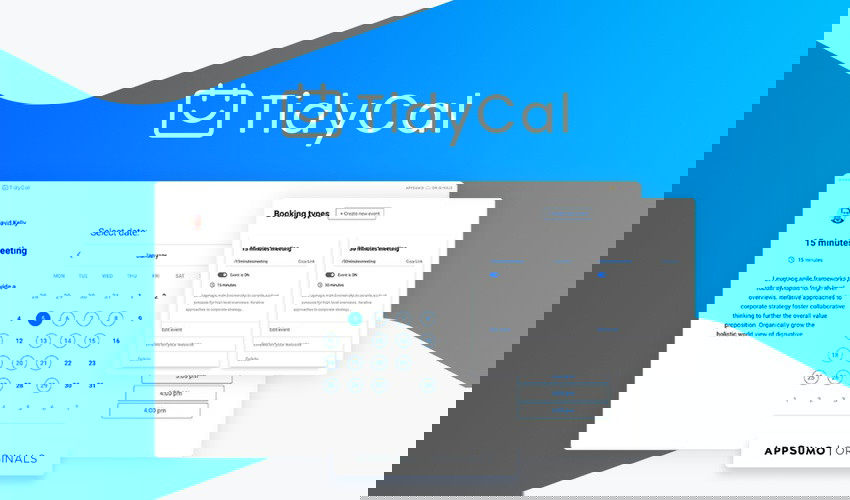
Where TidyCal shines for coaches: One-time payment instead of monthly subscription. Free forever plan with real functionality. Google, Outlook, and Apple Calendar sync. Payment acceptance via Stripe and PayPal with no commission on paid bookings. Package bookings. Easy import from Calendly if you are migrating. Extremely clean interface that non-technical coaches can set up in minutes.
Where TidyCal falls short: Branding customization is limited compared to BLAB or Bonsai. Some design features, like adding custom images to booking pages, are not as polished. If you need enterprise-level features or complex team routing, TidyCal is not the tool for you.
Pricing (2026): Free plan available. Individual Lifetime Deal $29 (one-time payment). Agency Lifetime Deal $79 (one-time payment, 10 calendar connections). All paid plans include a 60-day money-back guarantee via AppSumo. Get the TidyCal Lifetime Deal here.
Best fit for: Coaches on a budget who want a robust scheduling tool without recurring fees. Non-technical coaches who want something that just works out of the box. Anyone setting up scheduling for multiple clients or partners (agency plan).
7. Bonsai: The All-in-One Business Platform With Scheduling Built In
Bonsai is a full coaching business platform that happens to include scheduling. If you are looking for just a scheduler, Bonsai is overkill. But if you want one tool that handles scheduling, CRM, contracts, invoicing, client forms, and client portals all together, Bonsai is genuinely impressive.
What makes Bonsai different is the integration between scheduling and the rest of your business operations. When a client books a meeting through Bonsai, their contact information syncs to the CRM, you can send invoices and contracts from the same platform, and client session notes and files live in the same client portal.

Where Bonsai shines for coaches: Client forms that integrate directly into your website. Google Workspace and essential business tool integrations. Proposals, contracts, and e-signing built in. Financial management including invoicing, payments, accounting, taxes, and banking. Hundreds of free templates. A genuine all-in-one business backbone.
Where Bonsai falls short: The breadth can feel like overkill if scheduling is all you need. Pricing is higher than dedicated scheduling tools because you are paying for the full platform. New coaches may not be ready to commit to an all-in-one before they understand which features they actually need.
Pricing: Paid plans start at around $25/month for the Starter tier, with higher tiers for teams and advanced features. Source: Bonsai pricing, verified 2026.
Best fit for: Coaches who want one platform for their entire business, not just scheduling. Coaches running established practices who are tired of juggling five separate tools.
8. Trafft: Versatile Scheduling With Team and Payment Support
Trafft is a preconfigured tool that lets you set up your account and publish your schedule for appointment booking in just a few clicks. You can custom-brand your calendar, collect payments per appointment type, and manage a team of coaches from a single dashboard.
Trafft sits in a similar category to Bonsai as an all-in-one platform, but with a lighter footprint. It handles scheduling, payments, employee timesheets, invoicing, and tax handling. For coaching businesses with multiple coaches or several appointment types priced differently per coach, this makes direct allocation of bookings and payment attribution simple.

Where Trafft shines for coaches: Custom-branded booking pages. Payment collection per appointment type. Team management for coaching practices with multiple coaches. Fast, responsive customer support (we tested this ourselves and were impressed). Good educational content on their blog, including resources on building a coaching business plan.
Where Trafft falls short: The all-in-one nature can be overkill if you only need scheduling. It is less well-known than Calendly or Acuity, so your clients may find the interface unfamiliar at first. Adoption among coaches is lower than some alternatives, which can be a signal or simply a branding gap.
Pricing: Free plan available for basic use. Paid plans start at around $29/month and scale for larger teams. Source: Trafft pricing, verified 2026.
Best fit for: Coaching businesses with multiple coaches or team members who need unified scheduling, payment, and invoicing. Coaches looking for an all-in-one platform who find Bonsai too heavy.
Side-by-Side Comparison: 8 Scheduling Tools for Coaches at a Glance
The table below summarizes how Calendly and its seven alternatives compare on the criteria that matter most to coaches.
| Tool | Pricing Model | Starting Price (2026) | Free Plan | Best For |
|---|---|---|---|---|
| Calendly | Monthly subscription | $10/user/mo (annual) | Yes (limited) | Reliable default, broad integrations |
| BLAB (link) | Lifetime deal | One-time payment | No | All-in-one scheduling + landing pages |
| Acuity | Monthly subscription | $16/mo (annual) | No (7-day trial) | Package sales, detailed intake forms |
| Appointlet | Monthly subscription | ~$10/mo | Yes (forever) | Flexible meeting types, great support |
| HubSpot Meetings (link) | Free with CRM | Free | Yes | Coaches already using HubSpot CRM |
| TidyCal (link) | Lifetime deal | $29 one-time | Yes | Budget-conscious coaches, no recurring fees |
| Bonsai (link) | Monthly subscription | ~$25/mo | No | All-in-one business backbone |
| Trafft (link) | Monthly subscription | ~$29/mo | Yes (basic) | Multi-coach teams, integrated payments |
Which Scheduling Tool Should You Choose?
The right scheduling tool depends on where you are in your coaching practice. Three scenarios cover most coaches.
Case #1: If you are a new coach on a tight budget and want to minimize recurring costs: TidyCal is the obvious choice. The Individual Lifetime Deal at $29 replaces a $120+ annual Calendly subscription and handles most of what you need. For coaches who want scheduling plus landing pages without building a full website, BLAB is the better pick because the lifetime deal includes branded landing pages and payment collection in one tool.
Case #2: If you have an established practice and sell session packages or memberships: Acuity Scheduling is built for exactly this. Package bookings, SMS reminders, detailed intake forms, and payment collection are all first-class features, not bolted-on extras. The Growing plan at $27/month unlocks most of what package-selling coaches need.
Case #3: If you are building a small team or want one platform for your entire business: Bonsai and Trafft both work. Bonsai is the heavier, more feature-complete option if you want scheduling, CRM, contracts, invoicing, and a client portal in one platform. Trafft is the lighter alternative focused on multi-coach scheduling and payment attribution. For solo coaches who are already using HubSpot CRM, HubSpot Meetings eliminates the need for a separate scheduling subscription entirely.
What Coaches Should Do Next
Choosing a scheduling tool is not a decision to agonize over. Pick one that fits your current stage and budget, run it for 90 days, and only switch if it is genuinely failing you.
If you are starting out with zero budget: Set up TidyCal’s free plan or Appointlet’s forever-free plan today. Both take under 30 minutes to configure and will handle most coaching use cases.
If you have a few clients and want to look more professional: Invest in BLAB’s deal or Calendly’s Standard plan. Both give you a polished booking experience without breaking the bank.
If you are scaling past solo practice: Evaluate Bonsai, Trafft, or Acuity based on whether you want an all-in-one business platform or a best-in-class scheduler. Start with a free trial before committing.
The tool itself matters less than actually using it. A good scheduling tool you set up and forget is infinitely better than the “perfect” tool you never quite get around to configuring. Pick one today. Your next client is waiting to book.

COACHILLY MAG exists to help coaches succeed in business, not just in session. Our editorial team writes practical, no-fluff articles featuring actionable strategies on client acquisition, content marketing, pricing, and the business fundamentals that turn coaching skill into coaching income. Great coaching deserves a great business behind it.
Affiliate Disclosure: COACHILLY MAG reviews and recommends products we believe help coaches build better businesses. Some links in this article are affiliate links, which means we may earn a commission at no extra cost to you if you decide to purchase. Thank you for supporting our work.

